Washington State Car Insurance Requirements
The liability you must carry, the two coverages your insurer has to put in front of you, and what a ticket for no insurance really costs.
By Brookguard Editorial Team Updated 6 min read
- Liability minimum
- 25/50/10
- Fault system
- At-fault
- Must be offered
- PIP and UIM
- Avg. minimum policy
- $56/mo
The short version
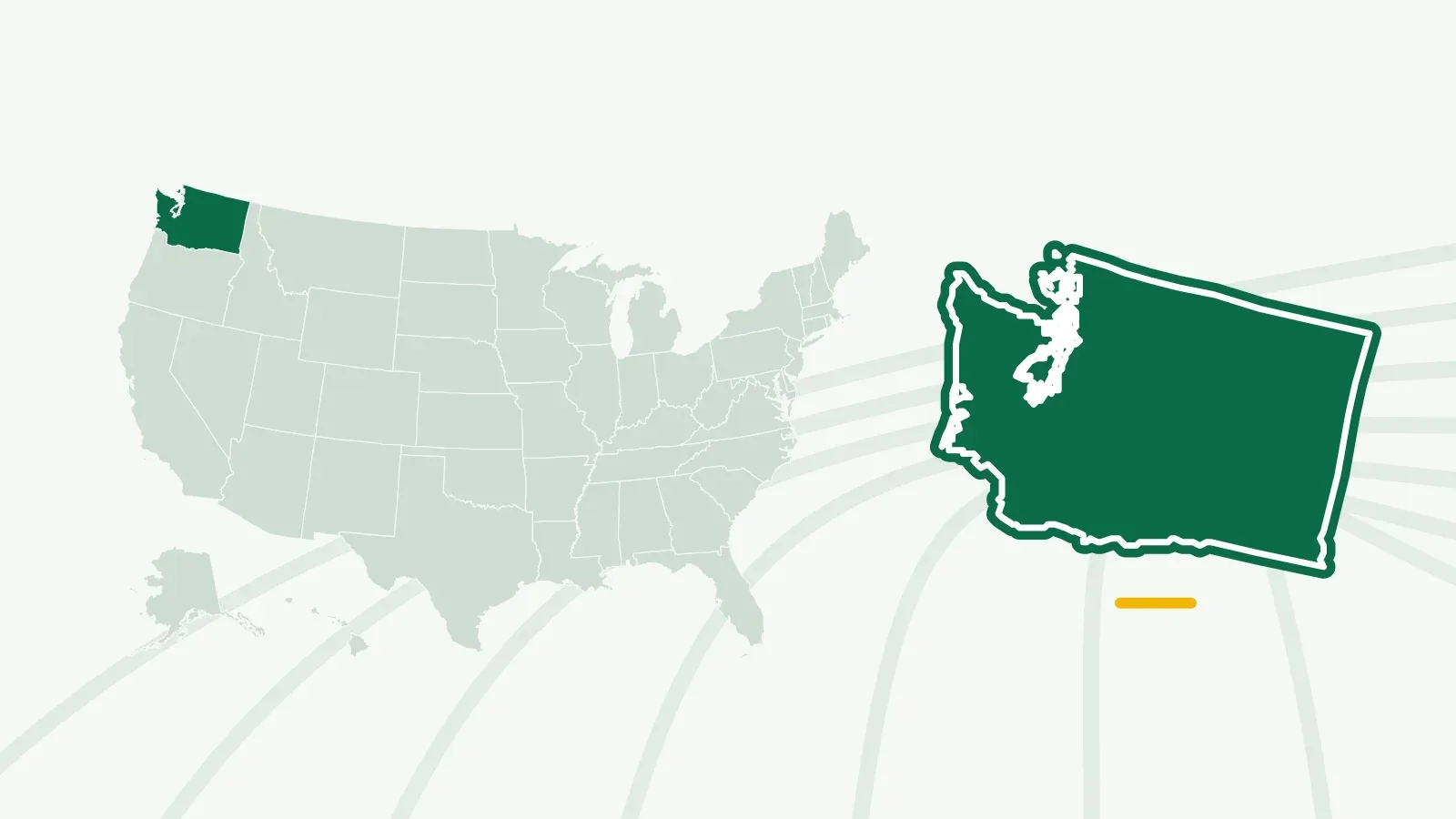
Washington requires liability coverage of at least $25,000 per injured person, $50,000 per crash and $10,000 for property damage. Your insurer must also offer personal injury protection and underinsured motorist coverage, which stay on your policy unless you turn them down in writing. Driving uninsured is a traffic infraction of $550 or more.
The legal minimum in Washington
Washington is a fault state: whoever causes the crash pays for the damage they did. The minimum policy is small by modern standards and has not changed in decades.
| Injury or death, one person | $25,000 |
|---|---|
| Injury or death, two or more people | $50,000 |
| Property damage, per crash | $10,000 |
Instead of a policy, you can use a liability bond or a certificate of deposit, or self-insure if you own 26 or more vehicles. Mopeds, horseless carriages over 40 years old and publicly owned vehicles are exempt.
Two coverages you get unless you say no
Personal injury protection
Pays you and your passengers regardless of fault. The basic offer covers at least $10,000 of medical bills, $10,000 of lost income (up to $200 a week), $5,000 for loss of services and $2,000 for funeral costs.
Underinsured motorist
Covers your injuries, and your car if you choose, when the other driver is uninsured, underinsured, or a hit-and-run. Limits normally match your liability coverage.
You may decline either one, but only with a written rejection, and it then stays off your later renewals unless you ask for it back in writing. Deductibles on underinsured property damage are capped at $100, or $300 for a hit-and-run. See our uninsured motorist page before you sign anything away.
Carrying proof of insurance
Keep your insurance ID card with you whenever you drive. It must show the insurer, the policy number, the policy dates and either your vehicle or your name. Washington law accepts the card in paper or electronic form, including on your phone.
Failing to show proof is a traffic infraction on its own, separate from the ticket for having no insurance at all. Keep the card current: an expired one does not prove anything.
What a ticket for no insurance leads to
- The ticket: a traffic infraction of $550 or more.
- An uninsured crash: if you are at fault and don't pay for the damage and injuries, the Department of Licensing can suspend your license under the Financial Responsibility Law.
- Getting your license back after that suspension typically involves an SR-22 filing from an insurer.
The bigger risk is the lawsuit. Without insurance, every dollar of the other driver's medical bills and repairs is yours, and courts can garnish wages to collect it.
Premiums in Washington
The 2026 statewide averages are about $668 a year for a minimum policy and about $2,389 a year for full coverage. Seattle-area ZIP codes, heavy commutes and repair costs push prices up, while rural eastern Washington tends to pay less.
Common questions
Is PIP mandatory in Washington State?
No, but your insurer must offer it and include it unless you reject it in writing. The standard offer starts at $10,000 for medical expenses.
How much is the ticket for driving without insurance in Washington?
The Department of Licensing lists it as $550 or more. A crash while uninsured can also cost you your license.
Can I show my insurance card on my phone in Washington?
Yes. State law allows an electronic image of the card on a phone or other portable device.
Sources
- Washington State Department of Licensing — Mandatory insurance
- Washington Office of the Insurance Commissioner — What's covered under an auto policy
- RCW 48.22.095 (minimum PIP benefits) and related sections
- CarInsurance.com — Average car insurance rates by state (2026)
Facts on this page were checked against these sources on October 12, 2026. A 2026 bill to raise the fine for driving uninsured did not pass, so the amounts above still apply.
Keep reading
-
Coverage
Personal injury protection
Pays your medical bills and lost income regardless of fault. Required in 12 no-fault states and a few others.
-
Coverage
Collision insurance
Repairs your own car after a crash, whoever caused it, minus your deductible. Required by most lenders.
-
Guide
How to file a claim
What to do at the scene, which insurer to call, working with adjusters and how to dispute an offer.