Car Insurance in Texas: What the Law Requires
The 30/60/25 minimum, how the state confirms you're covered, what a lapse costs, and the add-ons Texas drivers most often regret skipping.
By Brookguard Editorial Team Updated 6 min read
- Liability minimum
- 30/60/25
- Fault system
- At-fault
- Must be offered
- PIP and UM/UIM
- Avg. minimum policy
- $84/mo
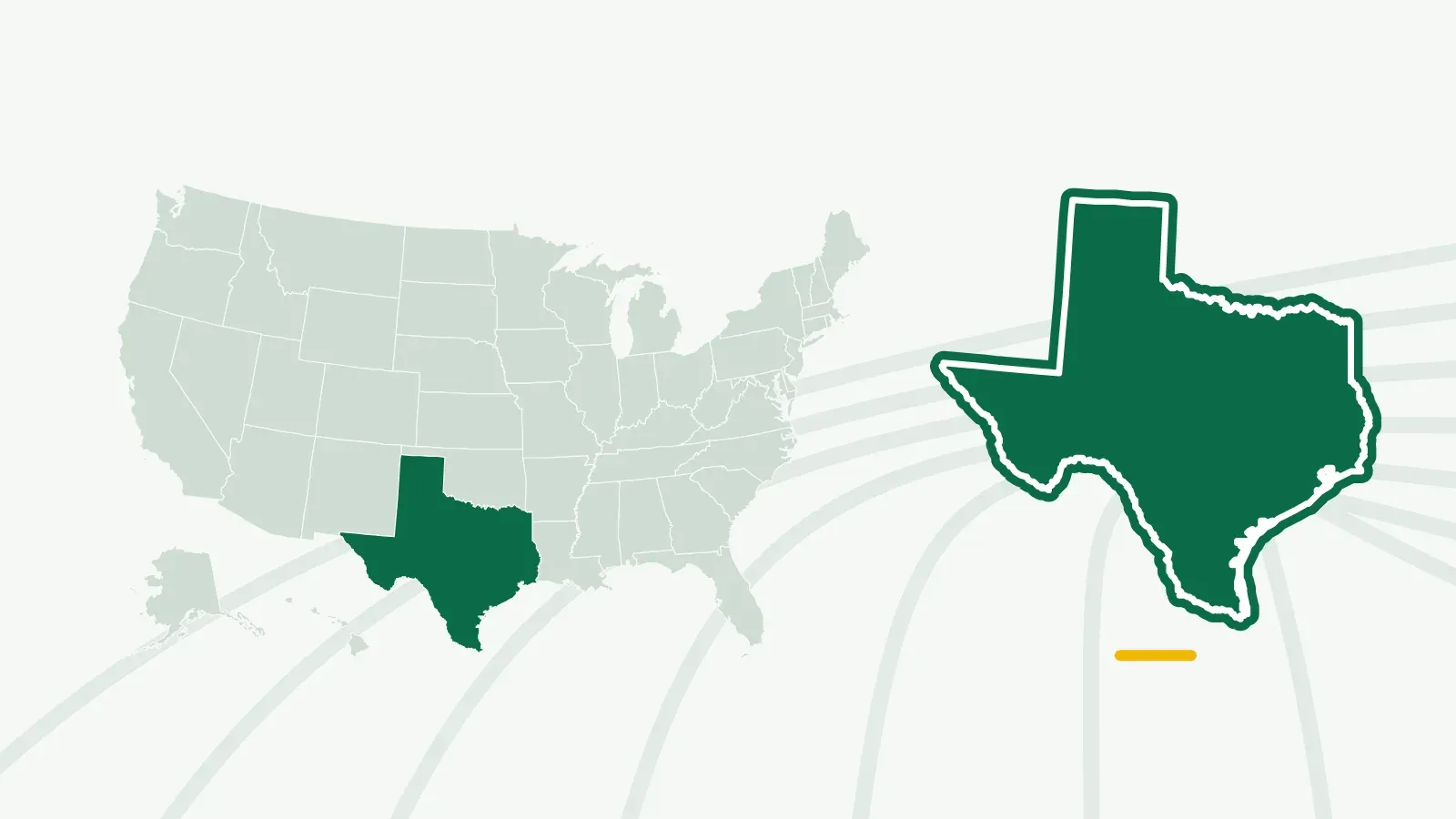
The short version
Every registered vehicle in Texas needs liability insurance of at least $30,000 per injured person, $60,000 per crash and $25,000 for property damage. Insurers must also offer personal injury protection and uninsured motorist coverage, which you keep unless you turn them down in writing. Police and the registration office can check your policy electronically through TexasSure.
The 30/60/25 minimum, line by line
Texas is an at-fault state: the driver who causes a crash pays for the other side's injuries and damage, usually through their liability policy. The Transportation Code sets the smallest policy you can legally drive with, written as three numbers.
| Bodily injury, one person | $30,000 |
|---|---|
| Bodily injury, all people in one crash | $60,000 |
| Property damage, one crash | $25,000 |
These limits pay other people, not you. Repairs to your own car and your own medical bills need separate coverage — see collision and personal injury protection.
Coverages Texas insurers have to offer
Two protections are built into most Texas policies by default. You can drop either one, but only by signing a written rejection.
Personal injury protection (PIP)
At least $2,500 per person for medical bills, lost income and similar costs after a crash, no matter who caused it.
Uninsured/underinsured motorist (UM/UIM)
Pays your injuries and, if chosen, car damage when the at-fault driver has no insurance or too little of it, including many hit-and-runs.
Proof of insurance and TexasSure
Keep proof in the car — a paper ID card or the digital card from your insurer's app both count. You'll be asked for it at traffic stops, after a crash and when you renew your registration. Most passenger cars no longer need a yearly safety inspection (that ended on January 1, 2025), but the 17 counties with emissions testing still check insurance there.
Behind the scenes, insurers report active policies to TexasSure, the state's verification database. An officer or county tax office can see whether a vehicle is covered without waiting for an accident, so a lapse tends to surface at the next stop or renewal.
What driving uninsured costs
- First conviction: a fine of $175 to $350, plus court costs.
- Later convictions: fines of $350 to $1,000, and a court can order a car you own impounded for 180 days.
- After a second conviction, your license is suspended unless you file proof of insurance and keep it on file for two years.
- An uninsured crash can also lead to suspension of your license and registration until you settle the damage.
A gap in coverage also tends to raise what insurers quote you later, so even a short lapse can cost more than the premium it saved.
What Texas drivers pay
Statewide averages in 2026 run about $1,006 a year for a minimum policy and about $3,106 a year for full coverage (liability plus collision and comprehensive). Your own price depends on your ZIP code, car, driving record and the deductibles you choose.
Hail, flash floods and long highway commutes make comprehensive and collision worth pricing even on an older car. Compare at least three quotes with identical limits — our quote comparison guide walks through it.
Common questions
Is Texas a no-fault state?
No. Texas uses a fault-based system: the driver responsible for a crash pays for the damage and injuries they cause, up to their policy limits and beyond them personally.
Can I show my insurance card on my phone in Texas?
Yes. A digital insurance card from your insurer is accepted at traffic stops and at emissions inspections, the same as a paper card.
Do I have to buy PIP in Texas?
Insurers must include it, but you may turn it down by signing a written rejection. Without it, your own medical bills after a crash fall to your health insurance or to the at-fault driver's insurer.
What is an SR-22 and when does Texas require it?
An SR-22 is a form your insurer files with the state to prove you carry insurance. Texas requires it after a second conviction for driving uninsured, among other serious violations, and you keep it on file for two years.
Sources
- Texas Department of Insurance — Auto insurance guide
- Texas Department of Motor Vehicles — Register your vehicle
- Texas Transportation Code, Chapter 601 (Motor Vehicle Safety Responsibility Act)
- CarInsurance.com — Average car insurance rates by state (2026)
Facts on this page were checked against these sources on October 12, 2026. Premiums are statewide averages, not quotes. State rules change — confirm with the Texas Department of Insurance before you buy.
Keep reading
-
Coverage
Liability insurance
Pays others for injuries and damage you cause. Required in 49 states and D.C.; minimums vary by state.
-
Coverage
Uninsured motorist coverage
Pays your injury costs when an uninsured, underinsured or hit-and-run driver is at fault. Required in many states.
-

Guide
Compare car insurance quotes
Keep limits, deductibles and term identical, check complaint and financial records, then switch with no gap.