North Dakota Car Insurance: The No-Fault Rules in Plain English
Four coverages every policy needs, when you can step outside no-fault and sue, how proof works, and what drivers here pay.
By Brookguard Editorial Team Updated 6 min read
- Liability minimum
- 25/50/25
- Fault system
- No-fault
- Also required
- $30,000 PIP, UM/UIM
- Avg. minimum policy
- $38/mo
The short version
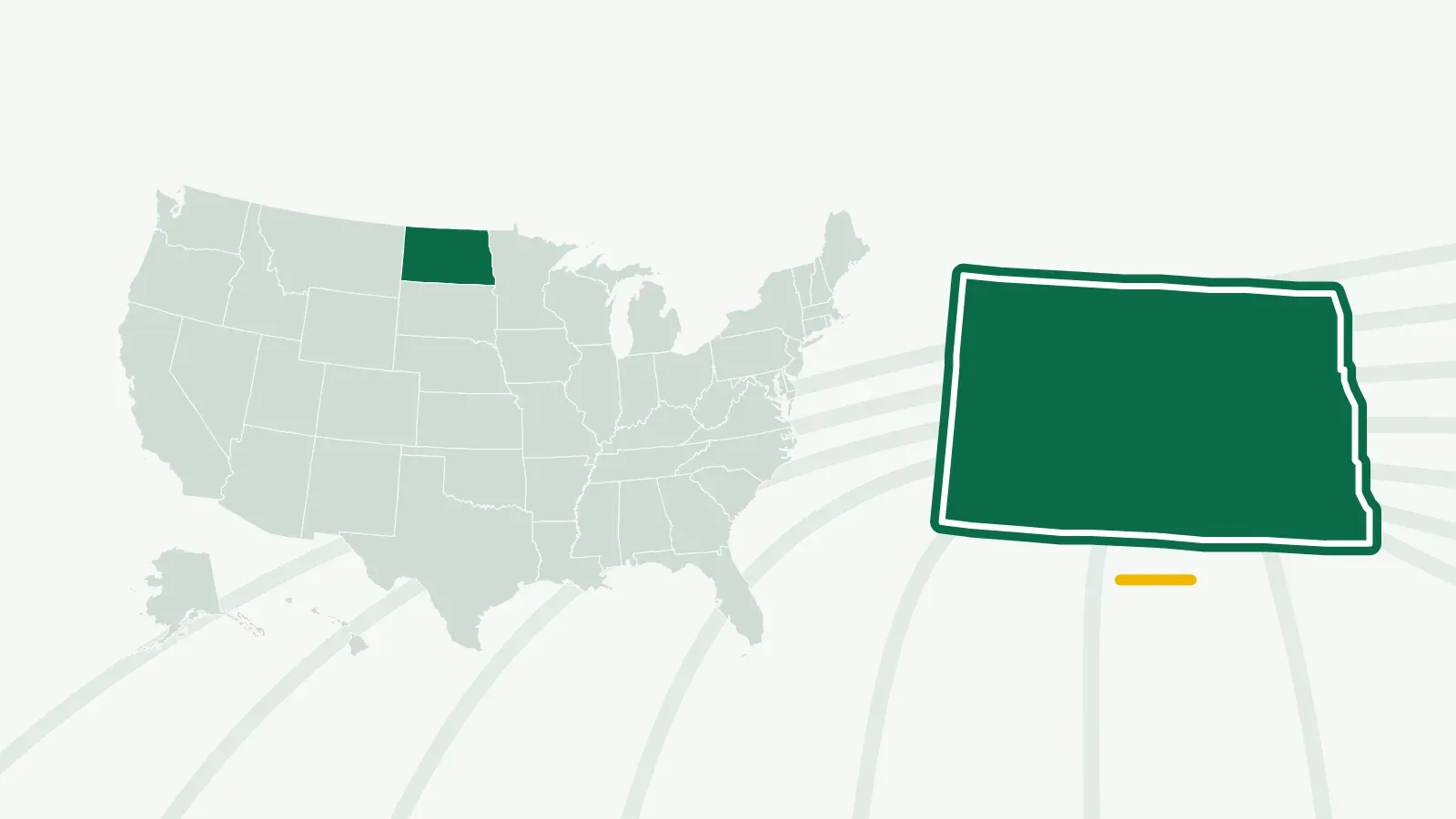
North Dakota requires liability of $25,000 per injured person, $50,000 per crash and $25,000 for property damage, plus $30,000 of personal injury protection and UM and UIM limits of at least $25,000/$50,000. Your own PIP pays your injury costs first, and you can sue for pain and suffering only after a serious injury or more than $2,500 in medical bills.
Four coverages on every North Dakota policy
North Dakota asks more of a basic policy than most at-fault states. A legal policy bundles liability for the people you hurt with three protections that pay you and your passengers.
| Bodily injury liability, one person | $25,000 |
|---|---|
| Bodily injury liability, one crash | $50,000 |
| Property damage liability, one crash | $25,000 |
| Basic no-fault benefits (PIP), per person | $30,000 |
| Uninsured motorist (UM) | $25,000 per person / $50,000 per crash |
| Underinsured motorist (UIM) | Must match your UM limits |
UM steps in when the driver who hurt you has no insurance. UIM covers the gap when that driver's policy is smaller than your losses. Neither one repairs your car — that job belongs to collision coverage.
How no-fault works after a crash
After an accident, you claim injury costs from your own insurer, whoever caused it. Your personal injury protection covers economic losses such as medical care and lost wages, up to $30,000 per person. Lost income is capped at $150 a week under the basic benefit, so a serious injury can outrun it quickly.
Damage to cars and other property does not follow the no-fault rule. The driver who caused the crash still pays for it through their property damage liability.
Showing proof of coverage
Carry proof whenever you drive. When an officer asks, you can show either a paper card or an electronic one on your phone; state law accepts both.
If you are cited but actually had a policy in force on that date, bring proof to the prosecutor's office and the charge can be resolved. A policy bought after the stop does not count.
What happens if you are caught uninsured
- A citation that goes to court, where a judge sets the fine and costs.
- After a conviction, you must keep proof of insurance on file with the North Dakota Department of Transportation; the statute currently sets this at one year.
- You surrender your license and pay $50 for a duplicate marked with that requirement, and another $50 to remove the notation later.
- If the proof lapses during that period, your driving privileges are suspended.
- On a second or later violation, the court impounds the vehicle's plates until you show insurance and pay a $20 fee.
The bigger risk is a crash. Without coverage, the other people's medical bills and repairs become your personal debt.
Typical premiums in North Dakota
A minimum policy averages about $462 a year in 2026, and full coverage with 100/300/100 liability plus collision and comprehensive runs about $2,439 a year. Your quote moves with your ZIP code, age, driving record, vehicle and deductible.
Deer strikes on rural highways, hail and long winters push many drivers toward comprehensive coverage, even on an older car. The coverage calculator suggests liability limits based on what you have to protect.
Common questions
Does my PIP pay if the other driver ran a red light?
Yes. In North Dakota your own personal injury protection pays first for your medical bills and lost income, no matter who was at fault. You can pursue the other driver only for property damage or once your injury crosses the serious-injury threshold.
Can I drop uninsured motorist coverage to save money?
No. UM and UIM are mandatory on North Dakota policies, and the two must carry the same limits.
Will a phone screenshot of my ID card work at a traffic stop?
North Dakota law accepts electronic proof of insurance. The safest choice is the official card in your insurer's app, which shows the current policy dates.
How long does a no-insurance conviction follow me?
You must keep proof of insurance on file with the state for a set period after the conviction, and your license carries a notation until it ends. Insurers may also price the conviction into your premium for several years.
Sources
- North Dakota Insurance Department — Auto insurance
- North Dakota Century Code, Chapter 39-08 (Section 39-08-20, driving without liability insurance)
- North Dakota Century Code, Chapter 26.1-41 (Auto Accident Reparations Act)
- CarInsurance.com — Average car insurance rates by state (2026)
Facts on this page were checked against these sources on October 12, 2026. Premiums are statewide averages rather than quotes, and penalties can change with new legislation, so confirm details with the North Dakota Insurance Department or NDDOT.
Keep reading
-
Coverage
Personal injury protection
Pays your medical bills and lost income regardless of fault. Required in 12 no-fault states and a few others.
-
Coverage
Uninsured motorist coverage
Pays your injury costs when an uninsured, underinsured or hit-and-run driver is at fault. Required in many states.
-
State
South Dakota
25/50/25 liability with UM and UIM matching your limits; 30-day to 1-year suspension if uninsured.