Wisconsin Car Insurance: Required, Offered and Optional
Wisconsin sorts coverage into three groups: what the law requires, what your insurer must offer, and what you add on your own. Here is how they fit.
By Brookguard Editorial Team Updated 5 min read
- Liability minimum
- 25/50/10
- Fault system
- At-fault
- Required UM
- 25/50 (injury only)
- Avg. minimum policy
- $62/mo
The short version
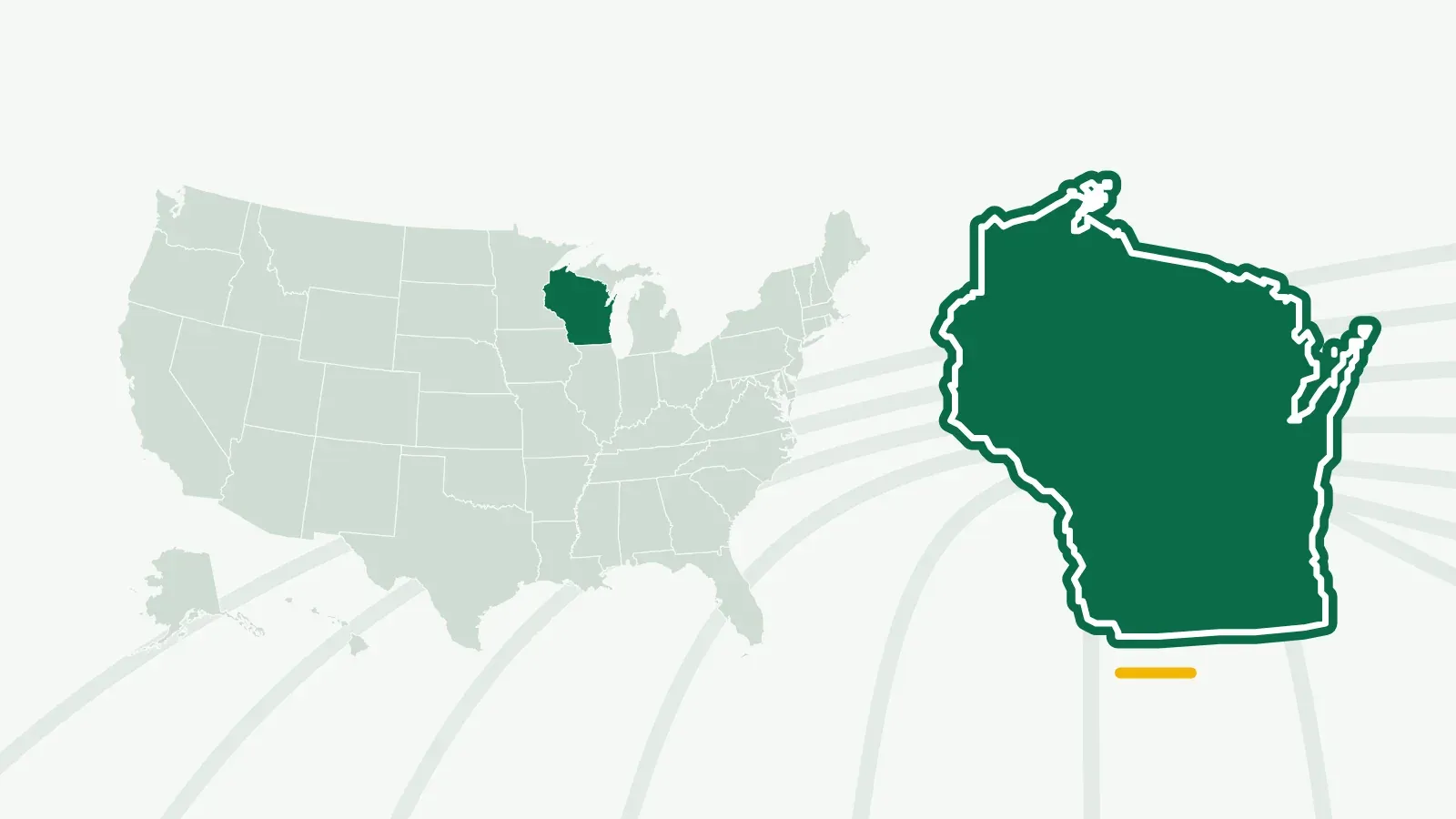
Wisconsin drivers must carry liability coverage of at least $25,000 per injured person, $50,000 per crash and $10,000 for property damage, plus uninsured motorist coverage of $25,000/$50,000 for injuries. Insurers must offer medical payments coverage and tell you about underinsured coverage, but you can decline both.
Required, offered, optional
| Bodily injury liability | Required: $25,000 per person, $50,000 per crash |
|---|---|
| Property damage liability | Required: $10,000 |
| Uninsured motorist | Required: $25,000 per person, $50,000 per crash (injuries only) |
| Medical payments | Must be offered; $1,000 minimum if you take it |
| Underinsured motorist | You must be told it's available; $50,000/$100,000 minimum if you buy it |
| Collision and comprehensive | Optional, though lenders usually require them |
Wisconsin is an at-fault state, so your liability coverage pays the people you injure and the property you damage. Note that the required uninsured motorist coverage pays for injuries only. It does not fix your car.
The coverages people decline and later miss
Medical payments pays medical bills for you and your passengers after a crash, whoever caused it. It is inexpensive and fills the gap before fault is sorted out.
Underinsured motorist coverage pays when the other driver is insured, but not for enough. A driver with the bare 25/50/10 policy cannot cover a serious injury, and this is the coverage that steps in. Our uninsured and underinsured motorist guide explains the difference.
Your insurer has to give you notice that underinsured coverage exists when the policy is delivered. If you ask for it, the floor is $50,000 per person and $100,000 per crash, which is double the required uninsured limits. Read the notice rather than filing it away: once you skip the coverage, it may not come up again at renewal.
Proof of insurance and lapses
Carry proof whenever you drive. Since 2013, Wisconsin accepts an electronic image on your phone, and the officer may look only at that proof, not the rest of your device. Expect to be asked for it at traffic stops and after any crash an officer responds to.
Penalties for driving without insurance
- Driving an uninsured vehicle: a forfeiture of up to $500, plus court costs.
- Failing to show proof when asked: a separate $10 forfeiture.
- Forging or knowingly showing fake proof, paper or electronic, is a separate offense.
The fines are modest. The real exposure comes after a crash: without coverage, you can be held personally responsible for the other people's losses, and the DMV can suspend your license under the state's safety responsibility rules until the damage is dealt with and you file proof of insurance.
What Wisconsin coverage costs
Wisconsin averages about $743 a year for a minimum policy and about $2,343 a year for full coverage in 2026. City ZIP codes usually cost more than rural ones; your record and vehicle explain most other differences.
Deer collisions are frequent on rural Wisconsin roads in autumn, and only comprehensive pays for them. The coverage calculator helps you weigh limits against your budget.
Common questions
Does Wisconsin require medical payments coverage?
No. Insurers must offer it, and the minimum is $1,000 if you accept it, but you can turn it down.
Will my Wisconsin uninsured motorist coverage repair my car?
No. The required coverage pays for injuries only. Damage to your car needs collision coverage.
What is the fine for no insurance in Wisconsin?
Up to $500 plus costs for driving uninsured, and $10 if you are insured but can't show proof.
Sources
- Wisconsin Office of the Commissioner of Insurance — Auto insurance FAQ
- 2013 Wisconsin Act 31 (electronic proof of insurance)
- Village of Elm Grove Police — Mandatory insurance citations (Wis. Stat. ch. 344)
- CarInsurance.com — Average car insurance rates by state (2026)
Facts on this page were checked against these sources on October 12, 2026. Forfeiture amounts are the statutory maximums; your citation lists the exact amount due.
Keep reading
-
Coverage
Uninsured motorist coverage
Pays your injury costs when an uninsured, underinsured or hit-and-run driver is at fault. Required in many states.
-

Coverage
Comprehensive insurance
Pays for theft, hail, flood, fire, animal strikes and glass damage to your car, minus the deductible.
-
Guide
Choose the right coverage
Build a policy in order: state minimums, liability that fits your assets, your car, your injuries.