New Hampshire Car Insurance: Optional, Not Free of Risk
How the state's financial responsibility law works, what any policy sold here must include, when you can be ordered to carry coverage, and what it costs.
By Brookguard Editorial Team Updated 6 min read
- Insurance required?
- Not for most drivers
- Policy minimum
- 25/50/25
- Built into every policy
- UM and $1,000 MedPay
- Avg. minimum policy
- $56/mo
The short version
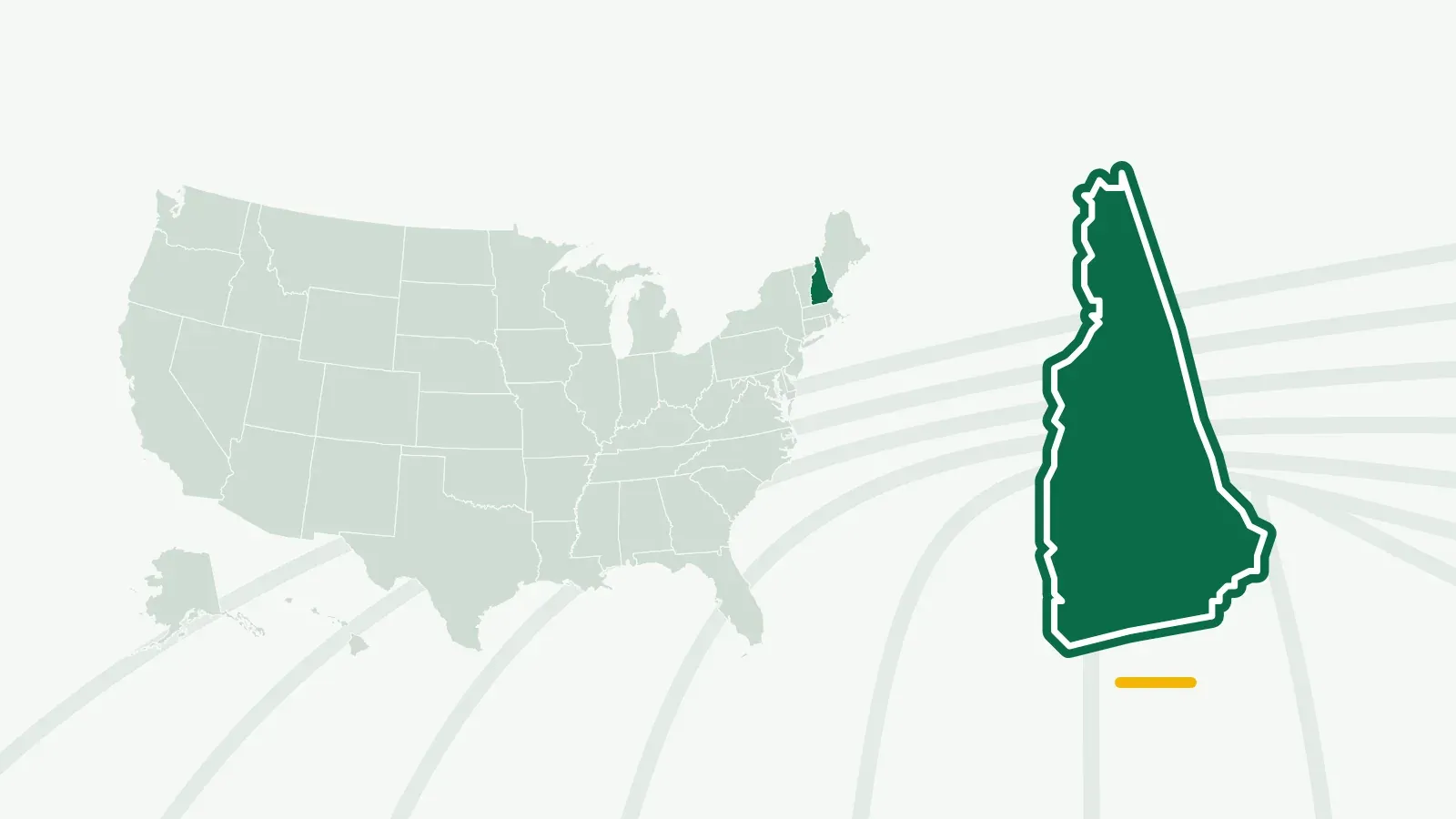
New Hampshire does not make most drivers buy car insurance, but you are still on the hook for any crash you cause. A policy sold in the state must include at least 25/50/25 liability, uninsured motorist coverage at the same limits and $1,000 of medical payments. Cause a crash without the means to pay, and the state suspends your license and registration until the damages are covered.
Optional insurance, mandatory responsibility
New Hampshire stands apart from every other state: there is no general rule that you must insure your car to register and drive it. What the law requires instead is financial responsibility: the driver at fault pays for the harm, insured or not.
The state enforces that after the fact. When a crash is reported and you have no policy, the Division of Motor Vehicles can suspend your license, registration and plates until you post security for the claims, settle them or satisfy a court judgment. A judgment counts as satisfied for this purpose at $25,000 per person, $50,000 per crash and $25,000 for property.
What a New Hampshire policy has to include
If you choose to buy insurance, the policy can't be bare-bones liability. State law builds three protections into every private passenger policy.
| Bodily injury liability, one person | $25,000 |
|---|---|
| Bodily injury liability, one crash | $50,000 |
| Property damage liability | $25,000 |
| Uninsured motorist | Equal to your liability limits |
| Medical payments | $1,000 per person |
Uninsured motorist coverage rises with your liability choice. If you buy 100/300 liability, your uninsured motorist coverage follows it up. Read more about it in our uninsured motorist guide.
When the state can order you to insure
Some drivers lose the choice. The state can require proof of future financial responsibility, typically an SR-22 filed by an insurer, after events such as:
- A reported crash you could not pay for.
- A DUI conviction.
- Leaving the scene of a crash without stopping or reporting.
- A second conviction for reckless driving or for excessive speed.
The filing has no fixed end date in the statute. The DMV may waive it after three years if you have no further convictions, crashes or unpaid judgments.
Proof of coverage and consequences
If you carry insurance, keep your card in the car and show it after a crash or when an officer asks. Because buying insurance is voluntary, there is no fine simply for not having it.
The real penalty comes after a crash. The license and registration suspension can last until the damages are paid, and the injured people can sue you for losses above any amount you settle. If you cannot pay in full, a court-approved installment plan may keep you driving, but a missed payment brings the suspension back.
Typical New Hampshire premiums
Statewide averages for 2026 are about $673 a year for a policy at the minimum limits and about $1,689 a year for full coverage, among the lower figures in the Northeast. Your town, vehicle, record and deductibles shape your own quote.
Snow, ice and moose crossings make collision and comprehensive worth pricing. The full coverage calculator shows how the numbers change with your car's value.
Common questions
Can I legally drive in New Hampshire with no car insurance?
Most drivers can. You must still be able to pay for any crash you cause, and the state can order some drivers to carry a policy and file proof.
If I buy a policy, can I skip uninsured motorist coverage?
No. Every standard policy issued in New Hampshire includes uninsured motorist coverage at your liability limits, along with at least $1,000 of medical payments coverage.
What happens if I cause a crash without insurance?
Your license, registration and plates can be suspended until you settle the claims or pay the judgment, and you remain personally liable for the full damages.
How long does a required SR-22 last in New Hampshire?
There is no set term. The DMV may lift the requirement after three clean years.
Sources
- New Hampshire Insurance Department
- New Hampshire RSA 259:61 — Minimum liability policy limits
- New Hampshire RSA Chapter 264 — Financial responsibility, uninsured motorist and medical payments rules
- CarInsurance.com — Average car insurance rates by state (2026)
Facts on this page were checked against these sources on October 12, 2026. We also confirmed that the 2026 bills to require insurance (HB 1558 and HB 1568) did not pass.
Keep reading
-
Coverage
Uninsured motorist coverage
Pays your injury costs when an uninsured, underinsured or hit-and-run driver is at fault. Required in many states.
-
Guide
Choose the right coverage
Build a policy in order: state minimums, liability that fits your assets, your car, your injuries.
-
State
New Jersey
35/70/25 standard minimum from 2026, $15,000 PIP, UM/UIM and a choice of lawsuit option.