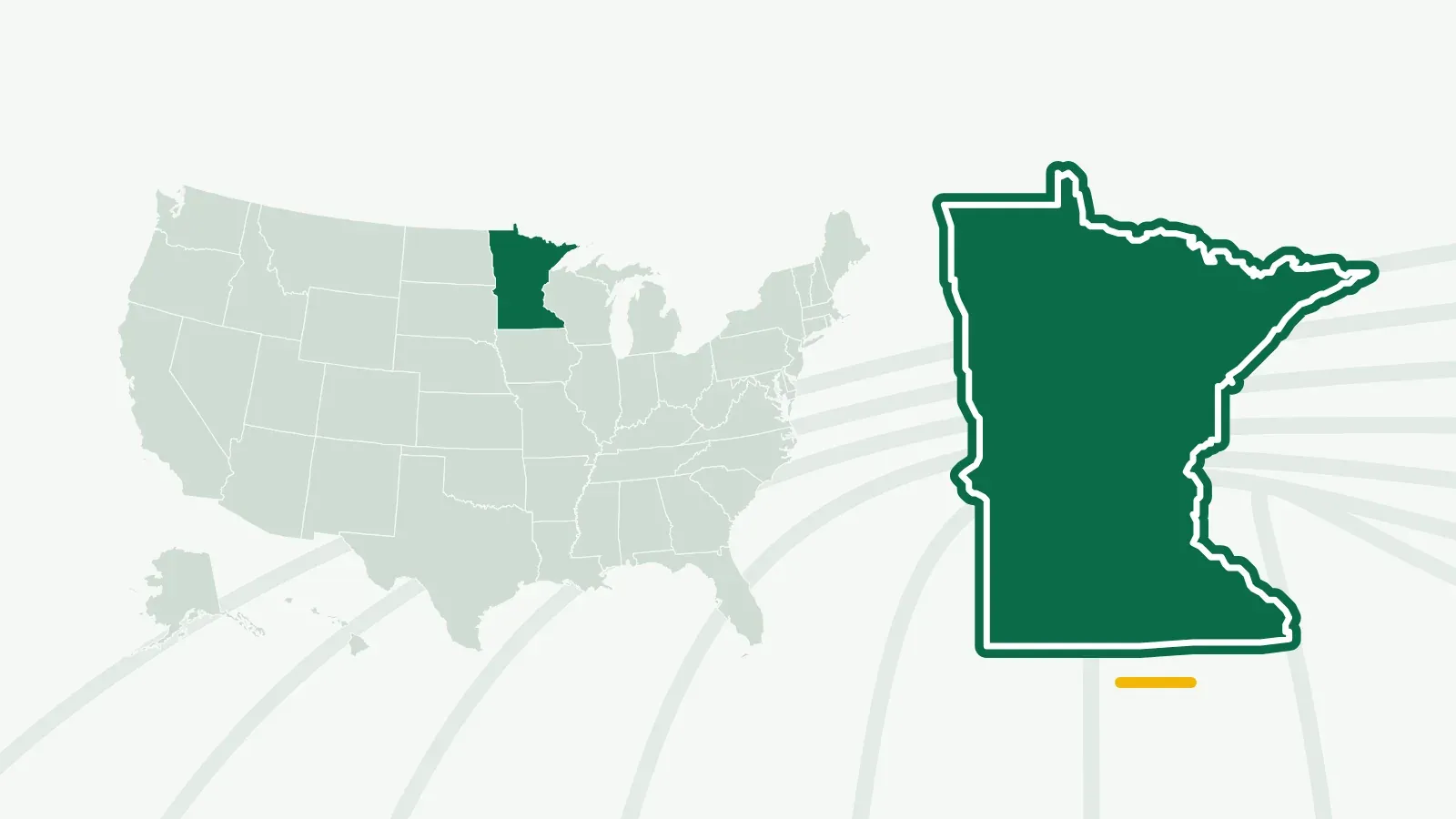
Minnesota Car Insurance: No-Fault Rules in Plain Terms
Five coverages, a lawsuit threshold and strict penalties. This is what Minnesota law expects from every driver and owner.
By Brookguard Editorial Team Updated 6 min read
- Liability minimum
- 30/60/10
- Fault system
- No-fault
- Also required
- PIP, UM and UIM
- Avg. minimum policy
- $92/mo
The short version
Minnesota requires liability limits of $30,000 per person, $60,000 per crash and $10,000 for property damage, plus $40,000 of no-fault personal injury protection and separate uninsured and underinsured motorist coverage of 25/50 each. Driving uninsured is a misdemeanor that can cost you your license for up to a year.
Minnesota's five required coverages
Any vehicle registered in Minnesota, or kept here most of the time, needs a policy with no-fault benefits and liability coverage. State law sets these floors:
| Bodily injury liability, per person | $30,000 |
|---|---|
| Bodily injury liability, per crash | $60,000 |
| Property damage liability | $10,000 |
| Personal injury protection (PIP) | $40,000: $20,000 medical, $20,000 non-medical |
| Uninsured motorist | $25,000 per person / $50,000 per crash |
| Underinsured motorist | $25,000 per person / $50,000 per crash |
A $10,000 property damage limit will not cover much more than a fender-bender with a late-model car. If you cause a bigger crash, you owe the rest. Raising your liability limits is often inexpensive compared with that risk.
What Minnesota PIP pays
PIP, also called basic economic loss benefits, pays you and the people in your household after a crash whoever caused it. The $40,000 is split into two pots:
$20,000 for medical expenses
Doctor and hospital bills, rehabilitation and other treatment tied to the crash.
$20,000 for non-medical losses
Lost income, help with household tasks you can't do while injured, and similar costs.
Because PIP pays first, many Minnesota crash injuries never turn into a lawsuit. Our PIP explainer covers the claim process.
When an injury claim can go to court
You can claim noneconomic damages, such as pain and suffering, from an at-fault driver only when one of these conditions is met:
- Your medical expenses from the crash total more than $4,000.
- The injury leaves you unable to carry out substantially all of your usual daily activities for 60 days or more.
- The injury is permanent or causes permanent disfigurement.
- The crash causes a death.
Damage to vehicles is not part of no-fault. The driver who causes the crash pays through property damage liability, or you use your own collision coverage.
Carrying proof of coverage
Minnesota drivers must have proof of insurance with them whenever they drive. An insurance card in electronic form counts, and showing it on your phone does not give the officer access to anything else on the device.
If you cannot produce proof when asked, that alone is a misdemeanor, with a fine of at least $200. Showing the court that the car was insured by your first court date can prevent a conviction.
Penalties for driving without insurance
- A misdemeanor with a mandatory fine of at least $200, and possible jail time.
- A gross misdemeanor if it happens within ten years of the first of two earlier convictions.
- Revocation of your driver's license for up to 12 months, and of the vehicle's registration if you own it.
- The state can also revoke registration and suspend your license administratively when its records show no coverage.
To get your license back, your insurer must file a written certificate showing you now have coverage.
Premiums across Minnesota
The 2026 statewide average is about $1,099 a year for a minimum policy and about $2,591 a year for full coverage. Twin Cities ZIP codes tend to cost more than rural ones, and your record, car and credit-based score also count. Spring hail and deer on rural roads are good reasons to price comprehensive coverage.
Common questions
How is Minnesota's $40,000 PIP divided?
Up to $20,000 for medical expenses and up to $20,000 for non-medical losses such as lost income and replacement services.
Do I need both uninsured and underinsured coverage in Minnesota?
Yes. They are separate required coverages, and each must offer at least $25,000 for one injured person and $50,000 for a whole crash.
When can I sue the other driver for pain and suffering in Minnesota?
When your medical bills exceed $4,000, you are disabled for 60 days or more, the injury is permanent or disfiguring, or the crash is fatal.
Sources
- Minnesota Department of Commerce — Auto insurance basics
- Minnesota Statutes 65B.49 — Required coverages and minimum limits
- Minnesota Statutes 169.797 — Penalties for failing to provide insurance
- CarInsurance.com — Average car insurance rates by state (2026)
Facts on this page were checked against these sources on October 12, 2026. Court fines can vary by county, so check your citation or ask the court for the exact amount owed.
Keep reading
-
Coverage
Personal injury protection
Pays your medical bills and lost income regardless of fault. Required in 12 no-fault states and a few others.
-
Coverage
Uninsured motorist coverage
Pays your injury costs when an uninsured, underinsured or hit-and-run driver is at fault. Required in many states.
-
State
Michigan
250/500 default liability (50/100/10 by form), PIP level you choose, $1 million PPI.