Insuring a Car in Alaska: The Rules That Apply to You
One of the highest liability floors in the country, a rare exemption for off-road-system towns, and what happens if you're caught without coverage.
By Brookguard Editorial Team Updated 6 min read
- Liability minimum
- 50/100/25
- Fault system
- At-fault
- Must be offered
- UM/UIM in writing
- Avg. minimum policy
- $57/mo
The short version
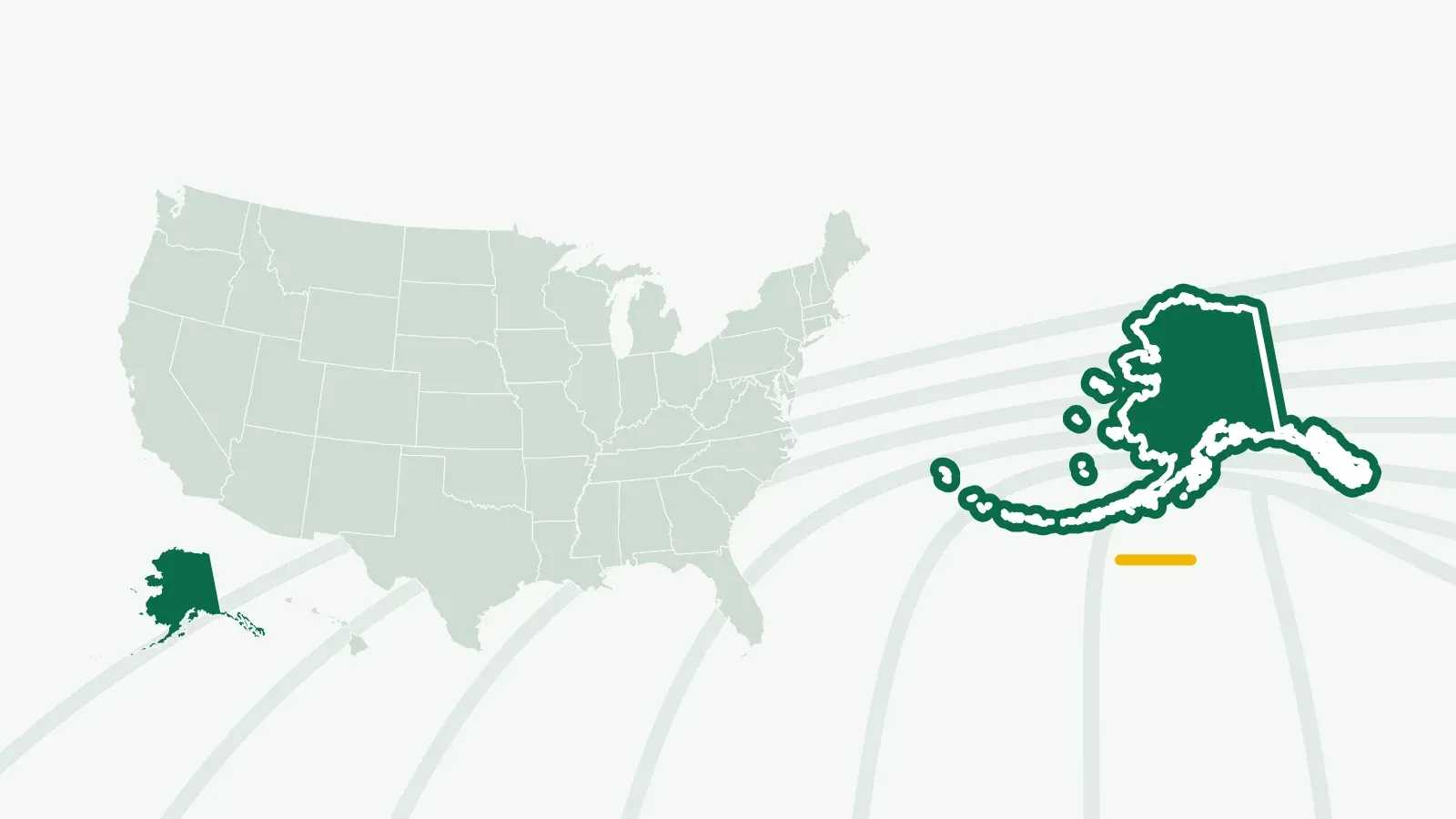
Alaska requires liability coverage of at least $50,000 per injured person, $100,000 per crash and $25,000 for property damage, double the bodily injury floor of many states. Communities where vehicle registration isn't mandatory are exempt, with exceptions. Driving uninsured can cost you your license, and after an uninsured crash you'll need an SR-22 on file for three years.
The 50/100/25 rule
Alaska uses a fault-based system. The driver who causes a collision is responsible for the harm, and liability insurance is how most people pay that bill. Liability is also the only coverage the law forces you to carry.
| Injury or death, per person | $50,000 |
|---|---|
| Injury or death, per crash | $100,000 |
| Property damage, per crash | $25,000 |
| Other required coverage | None |
These amounts protect the people you hit. They do nothing for your own truck or your own hospital stay. For that you need collision, medical payments or health insurance.
Where Alaska doesn't require insurance
Alaska is unusual: in areas where registering a vehicle isn't mandatory, the insurance requirement doesn't apply either. These are mostly small communities off the connected road system, such as Adak, Bettles, Gustavus, Point Hope and Unalakleet. State law lists them.
The uninsured motorist offer you'll sign
When you apply for a policy, the insurer has to give you a written offer of uninsured and underinsured motorist coverage, including limits that match your liability limits. Bodily injury and property damage are offered separately, so you can take one, both or neither.
- If you never sign to confirm your choice, the policy is issued with UM/UIM equal to your liability limits.
- If you reject it, your insurer doesn't have to offer it again at renewal, but you can ask to add it whenever you like.
- It pays your injuries when a driver with no policy, a thin policy or no name at all causes the crash.
Read more about how UM/UIM pays out before you decide.
Proof of insurance in Alaska
You must carry proof of coverage whenever you drive and hand it over when a police officer or an authorized Department of Public Safety employee asks. Paper and digital cards are both accepted. You'll also need to show proof after a crash that injures someone or causes significant property damage.
In the Municipality of Anchorage, police can impound a vehicle if the driver can't show proof. Getting it back runs through the Anchorage Police Department.
Consequences of driving without coverage
- Suspension of your driver's license, with longer suspensions for repeat offenses and for uninsured drivers involved in a crash.
- Reinstatement only after you show proof of financial responsibility and pay the DMV's reinstatement fees.
- An SR-22 certificate on file with the Division of Motor Vehicles for three years after a crash in which you had no insurance.
- Personal responsibility for every dollar of the other side's injuries and repairs.
Suspension lengths depend on your record and the circumstances, so check the exact terms on any notice the DMV sends you.
What Alaskans pay for car insurance
The statewide average in 2026 was about $681 a year for a minimum policy and about $2,167 a year for full coverage. Your price depends mostly on where you live, how far you drive, your record and the vehicle, and long winters plus costly parts shipping push repair bills up.
Moose and other animal strikes usually fall under comprehensive, and so does a windshield cracked by gravel on a frost-heaved road. Choosing a deductible you can actually pay matters here; see how deductibles work.
Common questions
Do I need car insurance if I live in a village off the road system?
Often not, if your community is one where registration isn't mandatory. The exemption ends if you've had 6 or more points on your record in the past 5 years.
Will an officer in Alaska accept my insurance card on my phone?
Yes. The DMV says proof of insurance can be in paper or digital form.
How long does an SR-22 last in Alaska after an uninsured crash?
Three years. It has to stay in force without a lapse, or your license can be suspended again.
Can I drop uninsured motorist coverage in Alaska?
Yes, by rejecting it in writing. If you don't sign a choice, your insurer must include it at the same limits as your liability coverage.
Sources
- Alaska Division of Motor Vehicles — Mandatory insurance
- Alaska Division of Insurance — Consumer guide to auto insurance
- CarInsurance.com — Average car insurance rates by state (2026)
Facts on this page were checked against these sources on October 12, 2026. Suspension periods and fees are set case by case, so ask the Alaska DMV which terms apply to your record.
Keep reading
-

Coverage
Comprehensive insurance
Pays for theft, hail, flood, fire, animal strikes and glass damage to your car, minus the deductible.
-
Coverage
Uninsured motorist coverage
Pays your injury costs when an uninsured, underinsured or hit-and-run driver is at fault. Required in many states.
-

Guide
Car insurance discounts
Safe-driver, student, safety, bundle and low-mileage discounts, plus policy changes that lower cost.