Louisiana Auto Insurance: The Rules Behind the Minimum
What a Louisiana policy has to include, why driving uninsured now costs far more after a crash, and how the state catches a lapse.
By Brookguard Editorial Team Updated 6 min read
- Liability minimum
- 15/30/25
- Fault system
- At-fault
- Included unless rejected
- UM coverage
- Avg. minimum policy
- $103/mo
The short version
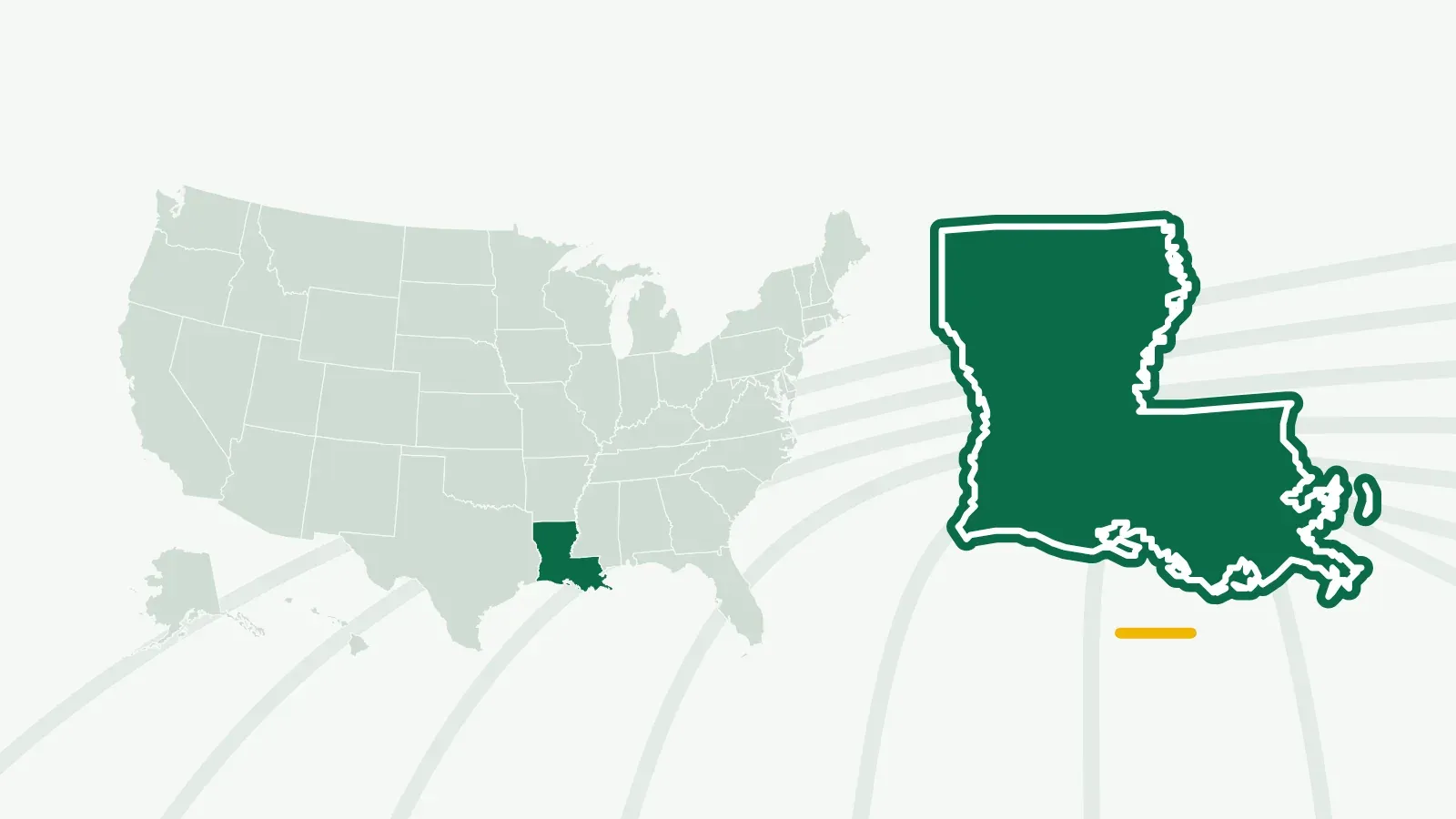
Louisiana requires liability insurance of at least $15,000 per injured person, $30,000 per crash and $25,000 for property damage. Uninsured motorist coverage comes with the policy unless you reject it on the state form, and since August 1, 2025 an uninsured driver gives up the first $100,000 of injury and property claims after a crash.
Louisiana's 15/30/25 floor
Louisiana is an at-fault state. If you cause a crash, your liability coverage pays the other people involved, and you are personally on the hook for anything past your limits. The law sets these limits as the smallest policy you may drive with.
| Bodily injury, per person | $15,000 |
|---|---|
| Bodily injury, per crash | $30,000 |
| Property damage, per crash | $25,000 |
Those figures are low by national standards. One night in a trauma unit can use up the $15,000 per-person limit, and many new trucks cost more than $25,000 to replace. Your own car and your own injuries are not covered by liability at all.
Uninsured motorist coverage is built in
Under Louisiana law, an auto policy must include uninsured motorist (UM) coverage at the same limits as your bodily injury liability. You can change that only by signing the form the insurance commissioner prescribes. The form gives you a few choices:
Keep matching limits
UM pays your injuries up to the same amount as your liability coverage when the other driver has little or no insurance.
Pick lower limits or economic-only
Lower limits cut the premium. Economic-only UM pays bills and lost income but not pain and suffering.
Reject it entirely
You save a little, but if an uninsured driver hits you, your own policy pays nothing toward your injuries.
With so many drivers carrying only 15/30, UM is often the coverage that actually pays after a serious crash. Our uninsured motorist guide explains how the claim works.
No pay, no play and the new fault rule
Louisiana punishes uninsured drivers twice: once by the state and again in court. Act 16 of 2025 raised the "no pay, no play" bar. For crashes on or after August 1, 2025, a driver who had no insurance is barred from recovering the first $100,000 owed for injuries and the first $100,000 owed for vehicle and property damage from the other driver, even if that driver caused the crash.
The statute lists a few narrow exceptions, so if you were uninsured and someone else caused the crash, read R.S. 32:866 or ask a Louisiana attorney before you assume you can or cannot recover.
How Louisiana checks your coverage
Insurers must tell the state when a policy starts and when it is canceled or lapses, within 15 business days. That data lets the Office of Motor Vehicles match vehicles to active policies, and the law directs the state to give police a real-time way to verify coverage.
Carry your insurance ID card in the car. An image of the card on your phone is accepted. If an officer stops you and you cannot show proof, the vehicle can be impounded and the plate removed until you show valid coverage.
What a lapse or uninsured stop costs
- The OMV can revoke the registration, impound the vehicle and cancel the plate.
- Reinstatement fees depend on the gap: $100 for 1 to 30 days, $250 for 31 to 90 days, and $500 for more than 90 days.
- An administrative fee of up to $25 can be added, plus towing and storage if the car was impounded.
- Unpaid fees become delinquent state debt after 60 days.
The bigger risk is a crash while uninsured. You pay the other side's losses yourself, and the $100,000 bar can wipe out most of your own claim.
Typical Louisiana premiums
Louisiana is one of the pricier states for car insurance. In 2026 a state-minimum policy averages about $1,231 a year, and full coverage averages about $3,999 a year. Lawsuit rates, repair costs and storm claims push prices up, and your ZIP code, record and car decide where you land.
Hurricanes and flash floods are the main reason to price comprehensive coverage, which pays for water damage to your own car. The coverage calculator can help you size liability limits above 15/30/25.
Common questions
Do I have to buy uninsured motorist coverage in Louisiana?
It is included by default at your liability limits. You can lower it, switch to economic-only, or reject it, but only by signing the state's UM form.
What happens if I'm in a crash without insurance in Louisiana?
For crashes since August 1, 2025, you cannot collect the first $100,000 of injury damages or the first $100,000 of property damage from the other driver, with narrow exceptions. You also face registration revocation and reinstatement fees.
Will the OMV know if my policy is canceled?
Yes. Insurers report cancellations and lapses to the state within 15 business days, so a gap can lead to revoked registration even without a traffic stop.
Sources
- Louisiana Department of Insurance — Auto insurance
- Louisiana R.S. 32:866 — Limits on recovery by uninsured drivers (as amended by Act 16 of 2025)
- Louisiana R.S. 32:863 — Sanctions and reinstatement fees for lapsed coverage
- CarInsurance.com — Average car insurance rates by state (2026)
Facts on this page were checked against these sources on October 12, 2026. Louisiana changed several crash-claim rules in 2025, so check with the Department of Insurance or the Office of Motor Vehicles if your situation depends on dates.
Keep reading
-
Coverage
Uninsured motorist coverage
Pays your injury costs when an uninsured, underinsured or hit-and-run driver is at fault. Required in many states.
-

Coverage
Comprehensive insurance
Pays for theft, hail, flood, fire, animal strikes and glass damage to your car, minus the deductible.
-
State
Mississippi
25/50/25 liability, real-time MSVIVS insurance checks, one-year suspension for driving uninsured.